What Is AI Slop? And Does It Really Ruin YouTube?
Artificial intelligence has made it possible to create videos faster, cheaper, and with fewer technical skills than ever before. A single person can now generate a script, narration, images, animation, music, and even an entire video using AI tools.
That sounds like an incredible creative revolution.
But there is a darker side to this new abundance: AI slop.
The term has become increasingly common across social media, YouTube, Reddit, and technology discussions. Critics use it to describe the seemingly endless stream of low-effort, mass-produced, AI-generated content flooding the internet.
But is AI slop actually destroying YouTube?
Or is the situation more complicated than the internet’s loudest critics suggest?
What Is AI Slop?
AI slop is a slang term for low-quality content produced with artificial intelligence, particularly when that content is generated quickly and in large quantities with little human creativity, editing, fact-checking, or original thought.
There is no single official definition of AI slop.
In general, the term describes content where the primary objective appears to be producing as much content as possible rather than producing something genuinely useful, entertaining, informative, or creative.
AI slop can include:
- AI-generated YouTube videos
- Automatically narrated videos
- AI-generated news stories
- Low-effort AI animations
- AI-generated celebrity stories
- Fake historical documentaries
- AI-generated children’s videos
- Clickbait videos using synthetic images
- Automatically generated listicles
- AI-generated music
- Repetitive YouTube Shorts
- Fake or misleading AI-generated news
- Channels producing hundreds of nearly identical videos
The important distinction is that AI-generated does not automatically mean AI slop.
An artist who uses AI as one component of a carefully produced film is not necessarily creating slop.
A filmmaker who uses AI to generate backgrounds, brainstorm ideas, or create visual effects can still produce highly original work.
The problem is not necessarily the AI.
The problem is the lack of human care behind the content.
Why Is AI Slop Suddenly Everywhere?
Generative AI dramatically reduces the cost of producing digital content.
Previously, creating a YouTube video might require:
- Research
- Writing
- Recording
- Editing
- Graphic design
- Music
- Thumbnail creation
- Publishing
Today, many of those steps can be automated.
That creates a powerful economic incentive.
If producing one video takes five hours, creating hundreds of videos is difficult.
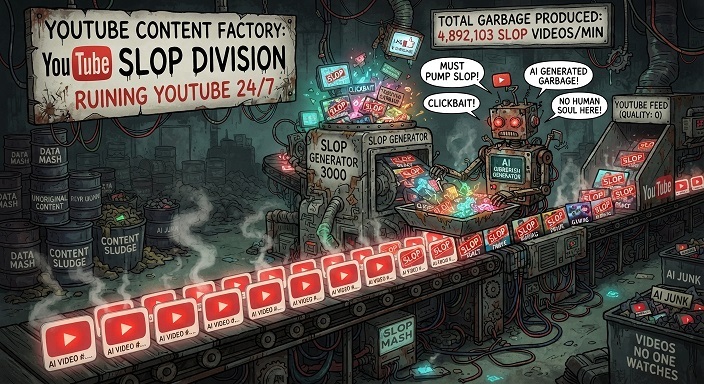
If AI reduces the production process to a fraction of that time, someone can potentially operate an entire content factory.
And that is where the concept of AI slop becomes particularly important.
The technology allows people to produce enormous quantities of content.
The internet then has to decide which of that content deserves attention.
What Does AI Slop Look Like on YouTube?
YouTube is particularly vulnerable to mass-produced AI content because the platform is built around recommendations, search, advertising, and enormous quantities of uploaded videos.
Some AI-slop channels follow remarkably predictable formulas.
A typical video might contain:
AI-generated script → AI voice → AI images → basic animation → dramatic music → clickbait thumbnail → upload → repeat.
The next video may use exactly the same formula.
Only the subject changes.
One video might be:
“10 Most Terrifying Places on Earth.”
The next:
“10 Most Mysterious Places on Earth.”
And then:
“10 Places Scientists Cannot Explain.”
The production line can continue almost indefinitely.
The result may technically qualify as a video, but viewers can often feel that something is missing.
There is little personality.
Little originality.
Little research.
And sometimes very little reason for the video to exist beyond generating another view.
Is All AI-Generated YouTube Content AI Slop?
No.
This is one of the most important distinctions in the entire AI-slop debate.
AI is a tool.
A camera can be used to make a masterpiece or a terrible video.
Photoshop can be used to create original art or spam.
A human writer can produce an insightful documentary or a meaningless article.
The same principle applies to AI.
A creator can use AI to:
- Research a topic
- Brainstorm ideas
- Create visual effects
- Generate concept art
- Translate content
- Improve audio
- Create animations
- Assist with editing
- Develop music
- Build prototypes
- Create fictional characters
- Produce entirely new forms of storytelling
There is nothing inherently “sloppy” about that.
AI slop is better understood as a production philosophy rather than simply a production technology.
The defining characteristic is often the combination of automation + low effort + repetition + little original value.
Why Are People Angry About AI Slop?
The backlash against AI slop is not simply about people disliking artificial intelligence.
There are several different concerns.
AI Slop Can Waste People’s Time
The first problem is obvious.
People search YouTube because they want information or entertainment.
If search results and recommendations become filled with low-quality videos, users have to spend more time filtering through garbage to find something worthwhile.
This is especially problematic when the content looks legitimate.
A polished AI voice and realistic AI images can make a completely fabricated video appear authoritative.
AI Slop Can Spread False Information
AI can generate convincing content very quickly.
That creates a serious problem for subjects where accuracy matters.
A person searching for information about medicine, history, science, finance, politics, or current events may encounter a video that looks professional but contains completely fabricated information.
A 2025 peer-reviewed study examining biomedical science videos on YouTube and TikTok found that 5.3% of the 1,082 videos it screened were judged to be probably AI-generated and low-quality. On YouTube specifically, 47 of 814 videos—5.8%—were classified as slop in that study. The researchers also found that the slop they identified was disproportionately concentrated in YouTube Shorts. (ScienceDirect)
That does not mean 5.8% of all YouTube videos are AI slop.
The study examined a specific educational subject area and explicitly warned that its methodology could underestimate the true prevalence.
But it does demonstrate that the phenomenon is measurable rather than purely an internet myth.
AI Slop Can Compete With Human Creators
This is perhaps the most controversial issue.
A human creator might spend days researching and producing a video.
Another channel might generate ten similar videos in a single day.
If the automated channel receives enough views, it can compete for the same advertising revenue and audience attention.
This creates a frustrating situation for creators who invest significant time in research, writing, filming, editing, and production.
The concern is not simply that AI can make content.
It is that industrial-scale content production can make quantity economically competitive with quality.
Does AI Slop Actually Ruin YouTube?
The Short Answer: Not Yet — But It Is a Real Problem
Saying that AI slop has “ruined YouTube” is probably an exaggeration.
But saying that there is no problem would be equally unrealistic.
Evidence suggests that low-quality AI-generated content exists on YouTube and can attract significant attention.
One 2025 analysis reported by The Guardian, based on research by video-editing company Kapwing, estimated that more than 20% of videos recommended to newly created YouTube accounts in its sample were AI slop. The analysis examined the top 100 channels in each of 15 countries and identified hundreds of channels producing what the researchers considered exclusively AI-slop content. (The Guardian)
That is a very different measurement from the biomedical study mentioned above.
And that is important.
There is currently no single reliable number representing “the percentage of YouTube that is AI slop.”
Different definitions, search methods, countries, topics, and recommendation systems produce very different results.
So the viral claim that “YouTube is now mostly AI slop” should be treated cautiously.
YouTube Is Fighting Back Against AI Slop
Interestingly, YouTube itself appears to recognize the problem.
In July 2025, YouTube renamed its “repetitious content” policy to “inauthentic content” and clarified that mass-produced and repetitive material is not eligible for monetization under the YouTube Partner Program. YouTube explicitly stated that the policy applies regardless of how the content was created. (Google Help)
That distinction is important.
YouTube isn’t simply saying:
“AI videos are banned.”
Instead, the platform is increasingly targeting mass-produced, repetitive, low-value content.
In July 2026, YouTube further clarified its policies around what it considers inauthentic content, including repetitive or template-based videos, emotionally manipulative content, and certain uses of AI personas around sensitive subjects. (TechCrunch)
YouTube’s own explanation is revealing: AI can allow creators to produce a much higher volume of content, and that can be positive when it results in higher-quality creative work. The problem occurs when the same technology is used for content farming—producing large quantities of generic videos with little creativity or narrative value. (TechCrunch)
In other words:
YouTube isn’t necessarily fighting AI.
It is fighting AI-powered content factories.
YouTube Is Also Increasing AI Transparency
YouTube has also been increasing disclosure around AI-generated and meaningfully altered content.
In 2026, YouTube announced more prominent labels for realistic AI-generated or meaningfully altered content. For long-form videos, the disclosure appears below the video player, while Shorts can display the disclosure directly on the video. YouTube also announced the rollout of additional internal signals intended to help identify AI-generated content. (blog.youtube)
That is significant because one of the biggest problems with AI-generated media is not necessarily that it exists.
It is that viewers may not know what they are looking at.
The Real Problem May Not Be AI — It May Be the Incentive System
This is where the AI-slop debate gets interesting.
YouTube has always had low-quality content.
Before generative AI, there were:
- Clickbait videos
- Content farms
- Reuploaded videos
- Reaction channels
- Fake thumbnails
- Sensationalist headlines
- Low-effort compilations
- SEO spam
- Repetitive Shorts
- Celebrity gossip factories
AI didn’t invent low-quality internet content.
AI simply made producing it dramatically cheaper.
That distinction matters.
The underlying problem is an economic system that rewards attention.
If a creator can make a video for $5 and generate $100 in advertising revenue, there is an incentive to make another video.
If AI reduces the production cost to $0.50, the incentive becomes even stronger.
And if the algorithm rewards the video, the production process becomes scalable.
That is how you get a content factory.
Could AI Slop Create an Internet Feedback Loop?
There is another potential problem that is less visible but arguably more important.
Imagine millions of AI-generated articles, images, videos, and social media posts being published online.
Now imagine future AI systems being trained or informed by material found on the internet.
If increasingly large quantities of the internet consist of AI-generated material, future systems could encounter more and more synthetic information.
This creates concerns about data quality and synthetic content feedback loops.
The internet could gradually become filled with content generated from other generated content.
That doesn’t mean the internet is doomed.
But it does mean that provenance, original sources, human expertise, and trustworthy information may become increasingly valuable.
Why Human Creativity Could Become More Valuable
There is an interesting paradox at the center of AI slop.
AI makes content easier to produce.
That means content itself becomes less scarce.
When everyone can generate an image, an article, a song, or a video in seconds, the mere existence of the content becomes less impressive.
What becomes scarce instead?
Human perspective.
Personality.
Experience.
Taste.
Humor.
Original research.
Authentic storytelling.
Expertise.
A creator who has something genuinely interesting to say may become more valuable precisely because the internet is increasingly filled with content that says nothing.
AI Could Actually Make YouTube Better
This is the part that often gets lost in the AI-slop debate.
The same technology that produces garbage can also dramatically improve legitimate content.
A small creator can now accomplish things that previously required an entire production team.
AI can help a creator:
- Translate videos into other languages
- Generate subtitles
- Improve audio
- Create visual effects
- Animate illustrations
- Research complicated subjects
- Develop story ideas
- Create prototypes
- Restore old footage
- Generate concept art
- Produce music
- Automate repetitive editing tasks
That could democratize filmmaking and online creativity.
A talented person with a good idea may be able to produce something extraordinary without needing a studio behind them.
So the future of YouTube doesn’t have to be humans versus AI.
It could be humans using AI versus humans using AI to produce meaningless content.
How Can You Tell If a YouTube Video Is AI Slop?
There is no perfect test, especially as AI-generated media becomes better.
But several warning signs can help.
Look for Repetition
If a channel publishes dozens of videos with nearly identical thumbnails, narration, structure, and pacing, it may be operating as a content factory.
Look for Missing Human Perspective
Does the video actually have an argument, opinion, experience, or original insight?
Or does it simply assemble generic information?
Check the Sources
Educational and factual videos should ideally provide sources that viewers can verify.
Watch for Strange Errors
AI-generated content can contain incorrect names, dates, images, quotations, locations, and historical details.
Examine the Channel
Sometimes the individual video looks convincing.
The channel tells the real story.
If a channel has uploaded hundreds of nearly identical videos across a short period, that is a warning sign.
So, Does AI Slop Ruin YouTube?
No—not by itself.
But AI slop can make YouTube worse if algorithms reward large quantities of generic, low-value content over original and useful work.
The important distinction is between AI-assisted creativity and AI-powered content farming.
One uses artificial intelligence to help humans create something better.
The other uses artificial intelligence primarily to create more things.
Those are very different goals.
And YouTube’s evolving policies suggest that the platform understands the difference.
The real battle may therefore not be AI versus humans.
It may be:
Quality versus quantity.
Originality versus repetition.
Human judgment versus automated production.
Information versus noise.
The Future of AI Slop May Be More Complicated Than We Think
AI slop is probably not going away.
As generative AI becomes cheaper and more capable, producing video content will become easier.
That means there will almost certainly be more synthetic content online.
But that doesn’t necessarily mean the internet will become unusable.
Platforms can improve recommendation systems.
Creators can differentiate themselves through originality.
Viewers can become better at recognizing low-quality content.
AI detection and disclosure systems can improve.
And importantly, audiences can simply refuse to watch things they don’t enjoy.
The history of the internet has always involved enormous amounts of junk.
AI has simply given the junk a new production engine.
Final Verdict: AI Slop Is a Problem, But AI Isn’t the Problem
AI slop is real.
It is already appearing across YouTube and other platforms, and there is evidence that some of it can attract substantial audiences.
But the claim that AI has already “ruined YouTube” is too simplistic.
The technology itself isn’t inherently bad.
A beautifully produced AI-assisted documentary isn’t AI slop.
An original animated story created by a small team using AI isn’t necessarily AI slop.
A musician using AI as part of a creative process isn’t automatically producing AI slop.
The problem is what happens when AI becomes a machine for producing enormous quantities of content with minimal human thought or responsibility.
That is the distinction worth remembering.
AI doesn’t ruin YouTube.
AI slop can.
And perhaps the most interesting question isn’t whether we can stop AI from creating more content.
It’s whether we can build an internet where the best ideas—not simply the most efficiently generated ones—still rise to the top.
Further Reading
- YouTube Channel Monetisation Policies — YouTube’s official guidance on monetization, including its rules concerning inauthentic, repetitive, and mass-produced content. (Google Help)
- YouTube: Improving AI Labels for Viewers and Creators — YouTube’s 2026 announcement about more prominent AI disclosures and additional detection signals. (blog.youtube)
- YouTube Clarifies Policies Around AI Slop — Coverage of YouTube’s 2026 clarification of its inauthentic-content policies. (TechCrunch)
- AI-Generated “Slop” in Online Biomedical Science Educational Videos — Peer-reviewed research examining AI-generated low-quality educational videos on YouTube and TikTok. (JMIR Medical Education)
- The Guardian: More Than 20% of Videos Shown to New YouTube Users Are ‘AI Slop’ — Reporting on research into AI-slop recommendations on YouTube. (The Guardian)
Got something to say? Join the chat