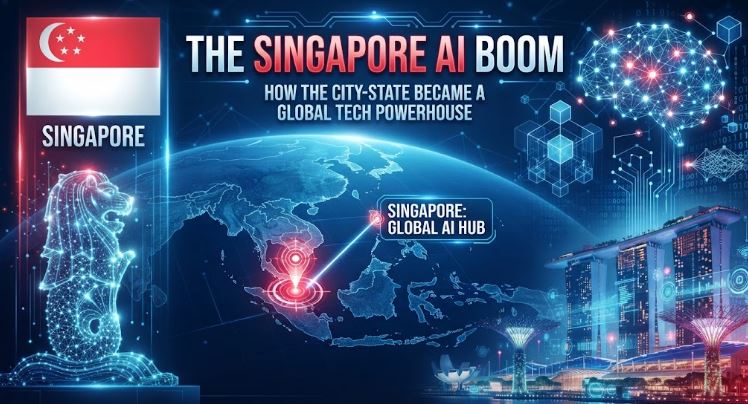
The Singapore AI ecosystem has transformed the city-state into a global powerhouse, making The Singapore AI Boom a leading force in modern technological innovation. Driven by a unique synthesis of proactive government policy, massive infrastructure investments, a top-tier educational system, and the aggressive attraction of global talent, the city-state has positioned itself not merely as a financial and logistical capital, but as a living laboratory for advanced technological innovation. Through targeted Singapore AI initiatives, local enterprises and international tech giants are rapidly accelerating their digital capabilities. Furthermore, the rapid expansion of Singapore AI research centers continues to attract top-tier global experts to the region.
The Rise of Singapore AI: Fueling a Technological Revolution
Understanding the Core Drivers Behind Singapore’s AI Boom
National Infrastructure and Strategic Vision: The National AI Strategy 2.0 The foundation of Singapore’s success lies in its targeted national frameworks. The National AI Strategy 2.0, unveiled by the Singaporean government, establishes a clear trajectory: transitioning from technology adoption to positioning the nation as a global leader in the responsible development and deployment of AI. This strategy extends far beyond theoretical academic research, aiming for the deep integration of AI across the entire economy, the enhancement of public services, and the cultivation of human capital. Operating through agencies such as the Economic Development Board (EDB) and GovTech, the government provides generous grants and tax incentives to technology firms establishing local R&D facilities.
Research Centers and Academic Excellence Singapore’s academic sector plays a pivotal role in fueling this ecosystem. Institutions such as the National University of Singapore (NUS) and Nanyang Technological University (NTU) consistently rank among the global elite in computer science and AI research. Working alongside them is A*STAR (Agency for Science, Technology and Research), which bridges the gap between academic theory and industrial application. These collaborative networks yield practical solutions tailored for logistics, smart cities, digital healthcare, and fintech.
Corporate and Industrial Integration Numerous multinational corporations—ranging from American tech giants to major Asian enterprises—have selected Singapore as the base for their regional AI operations. A business-friendly regulatory environment, robust intellectual property protection, and a stable legal system make Singapore fertile ground for developing complex algorithms and managing sophisticated cloud infrastructures. Within the financial sector, the Monetary Authority of Singapore (MAS) spearheads regulatory initiatives that encourage machine learning innovations for anti-money laundering and risk management, all while enforcing strict standards of ethics and transparency.
Navigating Challenges and Future Horizons Despite its phenomenal success, Singapore’s ecosystem navigates significant headwinds. The global shortage of specialized talent in machine learning and deep learning is strongly felt within the city-state, which contends with a high cost of living and fierce competition for top-tier professionals. Furthermore, geographical constraints and a heavy reliance on external resources necessitate highly specialized AI solutions for energy management, water security, and urban infrastructure. Nevertheless, fueled by targeted talent-immigration policies and continuous investments in professional upskilling, Singapore continues to cement its status as a global benchmark for mastering the AI revolution.
Remark:
Singapore does not have direct “pure-play” generative AI software companies listed locally, but several Singapore Exchange (SGX) listed semiconductor and precision engineering firms act as vital hardware and supply chain partners for the global AI boom.
Further reading: